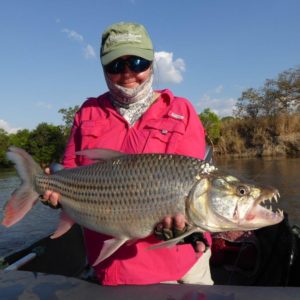
It had been a long-held dream of mine to go to India, but why? Mostly because I love travelling. Visiting Nepal gave me an introduction to this part of the world and with that, a desire to explore further. I particularly enjoy roaming remote corners of the globe world in pursuit of fish that many wouldn’t think of targeting, in this case, golden mahseer. The combination of a country so rich in history and culture, coupled with very remote fishing, targeting a little-known species, proved irresistible.
My Indian journey started at Indira Ghandi International Airport in Delhi, a gleaming expanse of glass, polished brass and miles and miles of carpet. It is easy to navigate and quick to get through. As you step out of the cool and quiet airport building, you step into a different world of noise and heat, of colour and a kaleidoscope of smells. Travelling through the seemingly chaotic traffic, this wonderful and vibrant city unfolds around you and I was delighted to have a little time to explore.
There are so many places to stay in Delhi, with options from luxurious five-star hotels like The Imperial and The Oberoi, which provide world-class amenities and services, to budget-friendly guesthouses and hostels that offer comfortable stays at affordable prices.
Starting off at the Palace and India Gate, before moving on to mosques and temples, the biggest challenge to moving around was the traffic but I had all day, so it was easy to sit back and let the city whirl around me. My explorations took me to Raj Ghat, a beautifully laid out memorial to Mahatma Ghandi. The surrounding gardens are beautiful and with the hustle and bustle of the main road behind you, it is incredibly peaceful. The perfume of the flowers on the breeze was delicate and the kites were soaring above in their dozens: I was humbled as I stood looking at the homage to a great man, thinking on all that he achieved.
The architecture of the Red Fort is stunning and leaving the serenity (relatively speaking) of New Delhi behind me, I set off to explore the heart of the old city. Mad and bustling, it is a cacophony of sound, smells, and humanity, all dodging past fruit sellers and carts piled high with produce of one sort or another. From there I moved on to Gurdwara Sis Ganj Sahib, one of nine historical gurdwaras in Delhi. Although a place of worship for Sikhs, people of all faiths are welcome and having respectfully covered our heads, we entered its very quiet but welcoming halls.
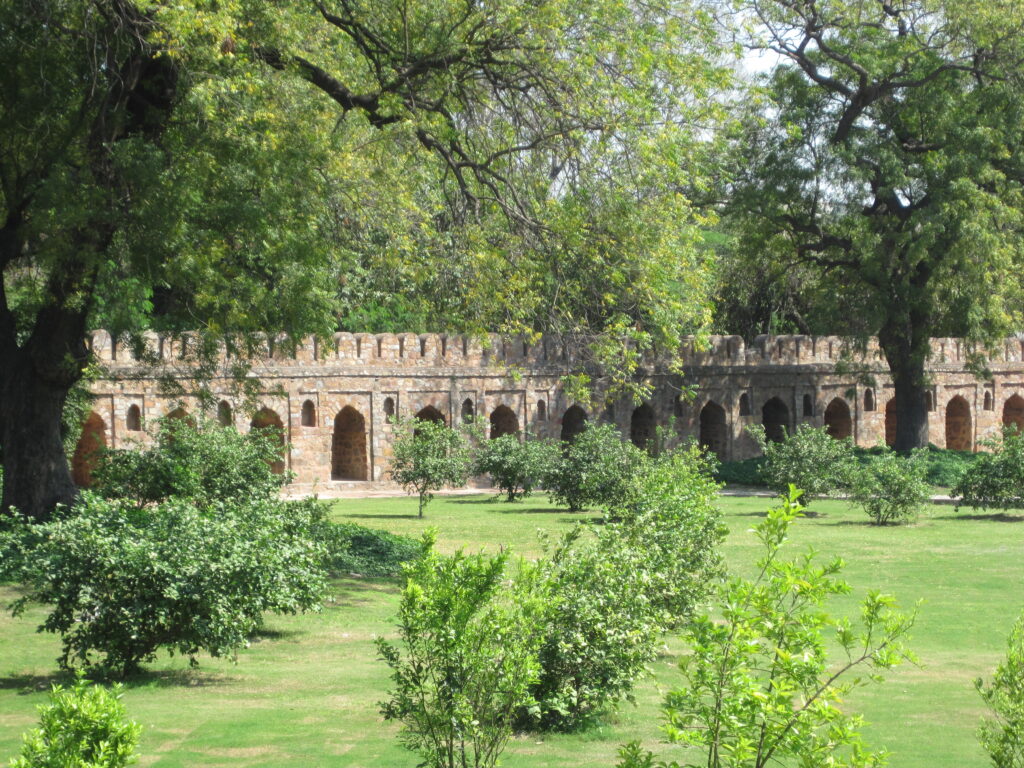
I ended the day visiting the Lodi Gardens which, spread over 90 acres, is home to several tombs, the oldest of which is the tomb of Mohammed Shah, built c1444. Started in the 15th century, the gardens are serene in their simplicity and are home to several mausoleums. The most striking of which is Humayun’s Tomb, memorable as much for its architecture and beautiful setting as the fact it was commissioned by a woman, Humayun’s senior wife, for her husband. Reportedly the first garden tomb on the Indian subcontinent, this Persian influenced building is constructed of red sandstone while the tomb itself is made of yellow and black marble. Having been declared a UNESCO world heritage site, it has undergone a fair amount of restoration and you could be forgiven for thinking that it looks more like a palace than a tomb. It houses not only Humayun and his wife but also various tombs of subsequent Mughal emperors and their wives. The influence of this beautiful building with its double dome, landscaped gardens and reflective water channels is seen in the Taj Mahal, built a century later by Humayan’s great grandson, Shah Jahan, in memory of his wife Arjumand Banu Begum.
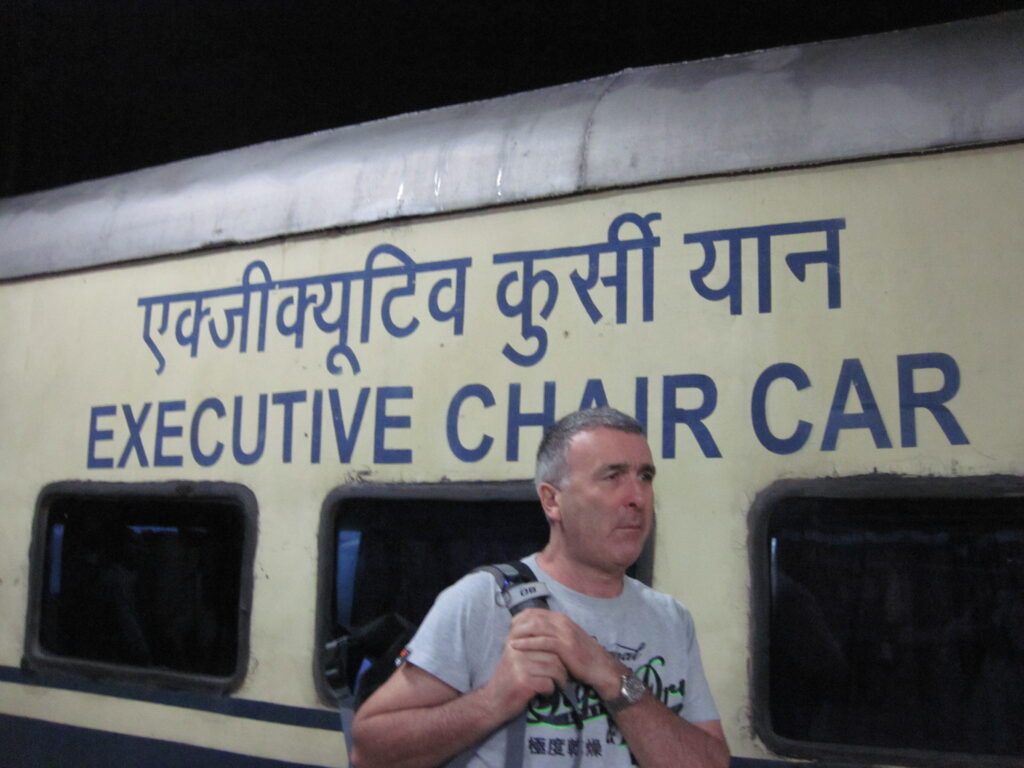
The next day started at 0430 as I set off for the station which was a heaving mass of humanity even at that very early hour. Once through that maelstrom, all was quiet. The platforms full of people sleeping, surrounded by their luggage. Leaving Delhi behind us on the train, the five-hour journey took us through fields landscaped by barley, rice and wheat. At journey’s end, I was handed over to my driver for the trip up to Ramganga River Lodge. Set high on a bluff overlooking the Ramganga, the camp has beautiful views in either direction. The opposite bank of the river is part of the buffer zone of Corbett National Park.
Floating lines and lighter flies were the order of the day and although we had been warned that sight fishing for mahseer is a tough game, we made our way down to the river, past the temple (offering a short prayer as I passed) and across the boulders to the clear waters of the Ramganga. We could see the mahseer but they weren’t interested in anything I presented to them; stripping fast or stripping slow didn’t entice them at all as we worked our way down the bank. We saw several fish rise and one very chunky fish jumped at one point but with the light beginning to fade, I made my way back up to the lodge. The dogs were returning from their afternoon rambles to have their leopard collars fitted for the night. Sitting round a fire and chatting is a such an easy pleasure and with the clear sky and a canopy of stars above, one that is hard to beat.
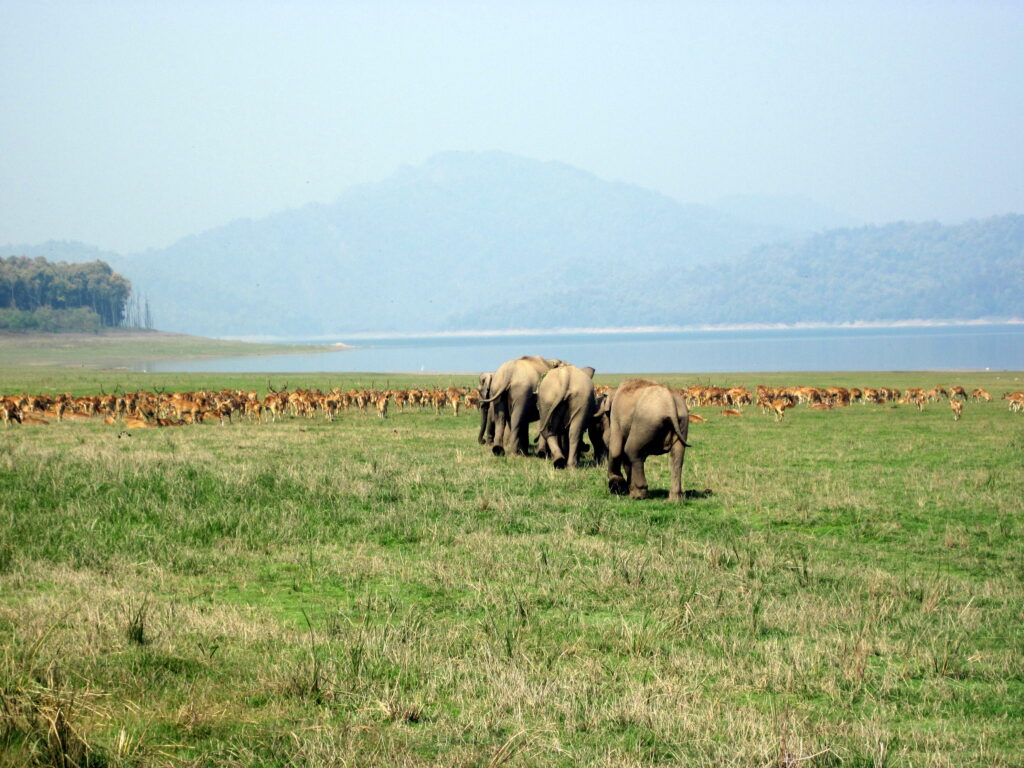
Jim Corbett National Park is India’s oldest park, established in 1936 to provide a haven for the endangered Bengal tiger. It is very diverse. In part hilly and heavily forested and in others marshy with riverine belts and with open grasslands surrounding an enormous lake. In days past, you could fish within the park boundaries but that is no longer possible. We saw an astonishing number of birds and in the areas of the park where lantana (an invasive plant species) hasn’t been able to get a toe hold, it is easy to see how well the tiger’s stripes camouflage them in the leaf covered, dappled shade of the towering trees. Elephant move across the grassland amid the herds of male white spotted deer and among the many other inhabitants I spotted were male and female sambar, female white spotted deer, golden jackals, wild boar, black faced languors and rhesus monkeys. On the riverbanks were the uniquely snouted fish eating gharials (Gavialis gangeticus) and the rather more formidable mugger crocodiles (Crocodylus palustris). From my vantage point above the river, the crystal-clear water did nothing to hide the enormous gooch lying just off a sand bar and several trophy sized mahseer hanging in the deeper pools.
I watched an otter work his way back and forth across the river before swimming straight at the mugger crocodile, turn and flick it with its tail and then scoot out of reach. The muggar swung around, and lunged at the otter, water flying everywhere and while the crocodile settled down, the otter was busy chasing fish the crocodile has spooked. Dangerous but clever.
The forest was alive with birdsong and amongst those we saw and heard were pied kingfishers, barbetts, sunbirds, woodpeckers, black drongos, Pallas’s fish eagle (including several juveniles), serpent eagles, peacocks, red jungle fowl and Kalij’s pheasant.
Leaving Corbett behind, I set off for the river on a road that climbed up and climbed down. We wound around and around, amazed by the vertical cultivation that must have taken generations to achieve. Wild cherry trees, apple and apricot shared space with wild mangos. The terraced hillsides eventually gave way to hillsides covered with towering pines, mainly Scottish pines introduced by the British both for lumber and to prevent erosion … after they had stripped the hillsides of its native cover. Rhododendron trees towered amongst the pines, covered in deep red blossom and as we gained height, we were aware that the air was getting cooler. Arriving at our hotel, we climbed up to reception to be greeted with a local drink made from rhododendron flowers before climbing again up to our rooms. This too is vertical living. Hot water bottles and fan heaters very necessary here as you are so high but the view out over the mountains was truly breathtaking.
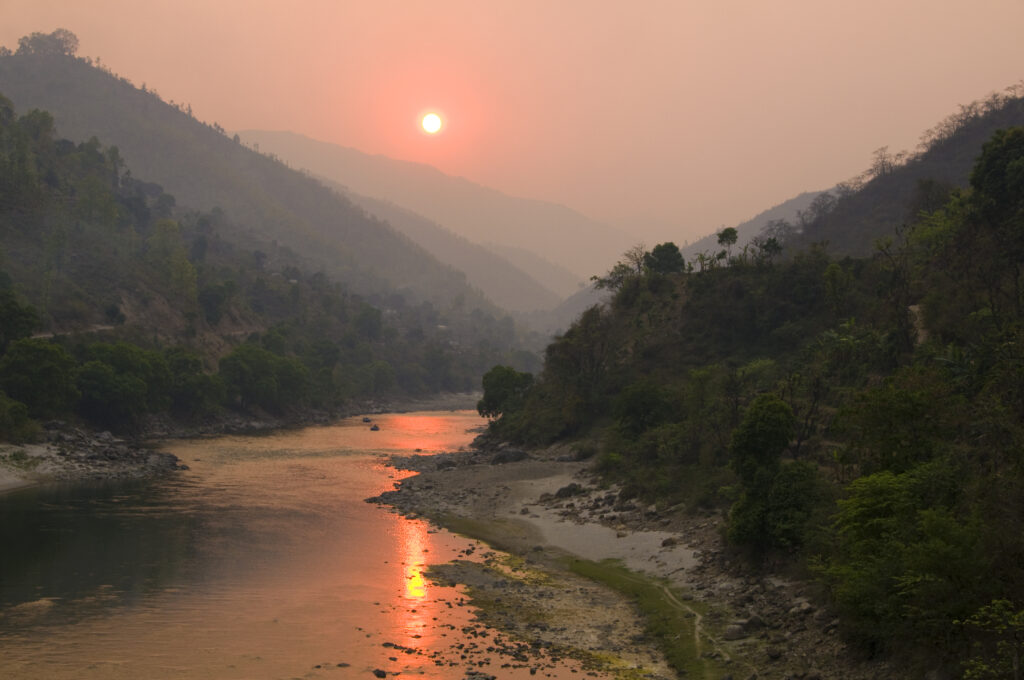
This last leg of our journey was towards warmer climes and the real reason I was here – the Saryu and Mahakali rivers and their beautiful, armour plated golden mahseer. We left at 0800 and set out on the winding road to camp, we climbed with the snow-capped peaks of the Himalayas and Everest to our left. Majestic and towering, they gleamed white in the morning haze. The mountainsides changed to smaller, indigenous pines which gave way to terraces with flocks of grazing sheep. Occasionally we passed cows and horses grazing loose by the roadside, obviously used to not straying far. It is a long drive in; scenic to be sure and with a leg stretch or two en-route.
Having spotted the river to our left, we wound down and down until finally we arrived at the police check point. As the river is the border with Nepal, our passports were checked and we were soon waved on our way. A short but steep walk had us down on the riverbank to be ready for the short journey across the river to camp.
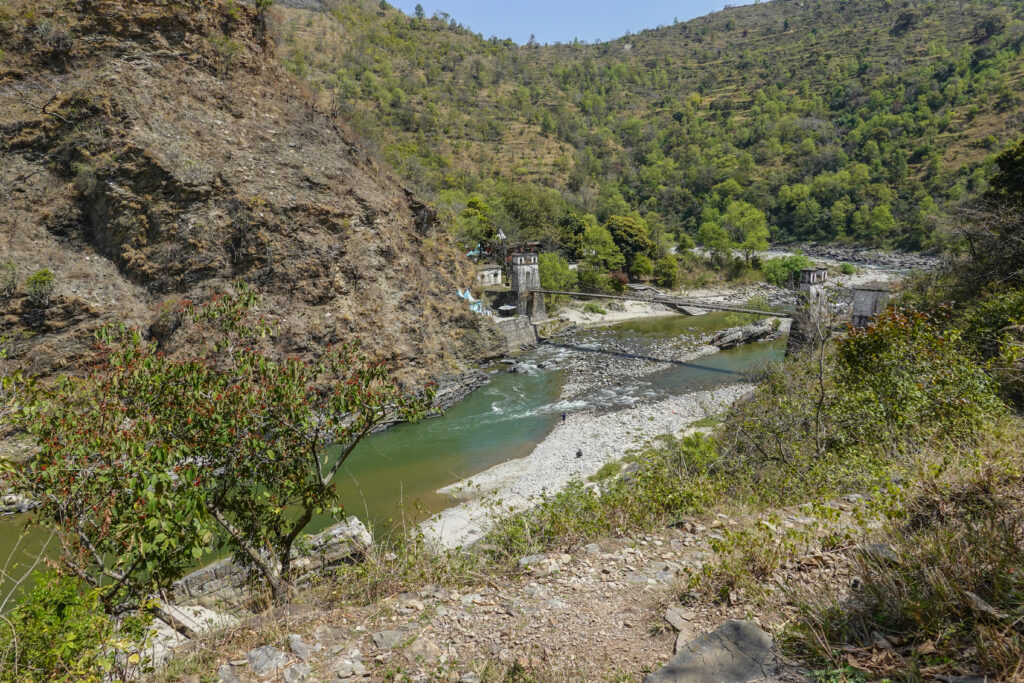
Camp is very simple; Meru style tents, all with twin beds, covered porches front and back, fresh long drop loos (your flush is your shovel), shower tents and a bucket bath tent. There is a central dining area, with one long communal table and on slightly lower ground, the evening fire. There is plenty of iodised water for hand washing, anti-bacterial soap and, at night, a hot water bottle if you would like one. We settled in and tackled up. After lunch and a short siesta, we enjoyed about two hours on the stretch of the Saryu immediately in front of camp. NB since my visit, the camp has been upgraded with larger tents and bathrooms with running water and flush loos.
Evening meals always started with an appetiser around the fire before we moved to the table for the next two courses. The food truly is delicious, highly flavoured but not spicy hot – there is a very real danger of being overfed. The hot stuff is on the table if you want it.
Up at 0700 with tea and biscuits in bed, hot water added to the water container outside the tent, breakfast at 0800 and we were off by 0900. With four fishing, we had a guide each and parted company to fish our separate beats. I was fishing the confluence of the Saryu and the Mahakali which, for mahseer fishermen, is as famous as the Junction Pool on the Tweed is to British salmon fishermen. On our side of the river was the temple with prayer flags flying gently in the breeze which carried with the scent of incense and of curries cooking. On the other side of the river a ghat, a series of steps leading down to the river, also of spiritual significance. From my perch above the confluence, you could clearly see the difference in colour; the Kali was a milky green against the coffee-coloured Saryu. The plan was to be out all day and have a picnic lunch under the trees.
Tackling up the previous afternoon, I had quickly realised that I was going to have another challenge on my hands – that of casting heavy sinking lines, with heavy tube flies on my Hardy Proaxis 7#. It was a short and painful learning curve but having whacked myself on the back a couple of times, I decided that one false cast would be enough. Working the fly and fishing the pool down, I felt a hard bump and reacted with a hard strip strike; perfect for the bonefish it felt like but not much good on a mahseer.
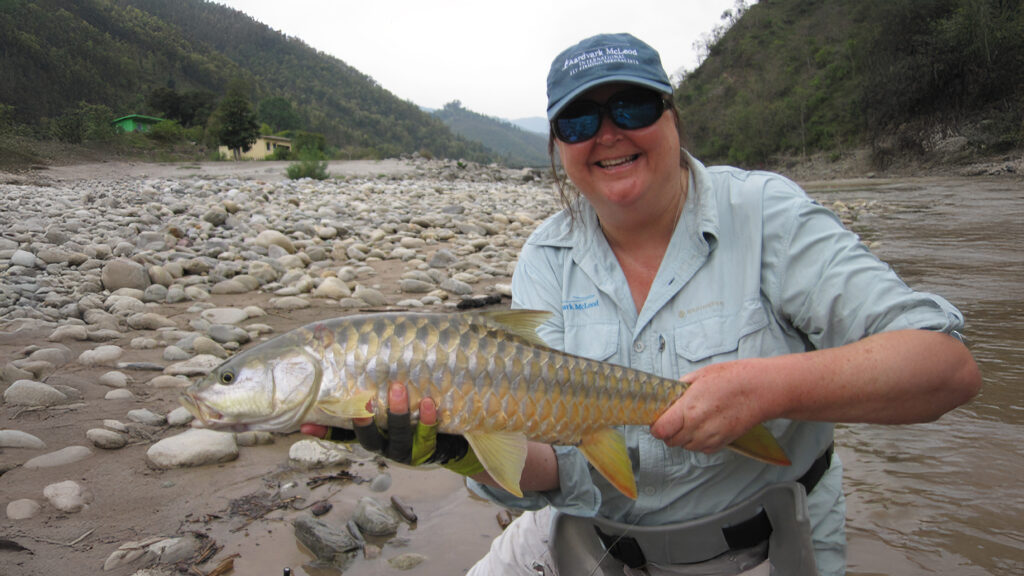
I took a ten-minute break to reclaim my mojo and ten minutes after I started fishing again, as my fly reached the end of its swing, I stripped once and had another massive hit. Much harder this time, it felt like a small GT had just hit my fly. Lifting the rod, I got the line back on the reel and let the fish run. Run it did and it took me straight into my backing, showing no signs of stopping as it headed right down past the confluence and into the Mahakali. Not looking forward to running after it across the boulder field, I was determined not to lose this fish and equally determined not to break an ankle. Just as I thought I was going to have to boulder hop, it slowed and with the backing eventually retrieved, we had few more short runs and a last wee tussle before I was able to bring it to the bank. Cradling the fish, Misty gently attached the bogar grip and removed the fly as I clambered down the rocks and into the water. I was truly taken aback by the beauty and the depth of its colour. I have seen beautiful photographs of mahseer close up, but nothing can prepare you for seeing one in person. Using a line tray or stripping basket is highly recommended as your line will wrap around the rocks and river debris if you aren’t using one.
We had a different plan for the following day; up at 0500, out by 0600 and with breakfast on the river. Watching the sun rise over Nepal, while walking down to the river was really very beautiful. I was on the other side of the river that morning, fishing the right-hand bank of PJ’s pool down to the confluence. Back in camp, it was time to wash up for lunch before heading out again about 1600. This time, starting where I had stopped in the morning and working down to the bottom of the run. As my fly stopped swinging, I stripped once, short and fast, and bang. Fish on. However, this fish didn’t run. It sulked. Short bursts were followed by a tussle which eventually degenerated into a tug of war. A smaller fish at six pounds, it actually made me work harder! It was a beautiful fish with lovely colouring on is belly.
The following morning, we were on the move; heading down to the fly camp on the Mahakali for the night. It is a wonderful 10km drift with a few grade I rapids to keep you cool. Along the way, Misty pointed out the marks on the wall that the mahseer make when they are scratching for alternative food sources. It didn’t take long for the fly camp to come into view; a smaller and simpler version of the main camp.
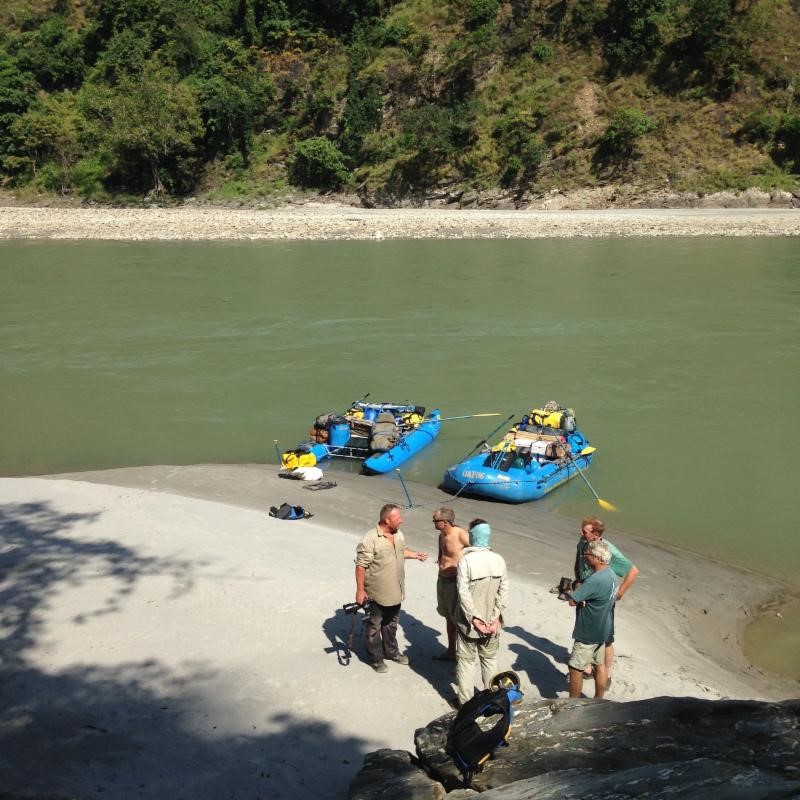
We saw snow trout rising but, best targeted on dry fly, and with the visibility so poor, the guides thought that our efforts would be better spent on mahseer. Snow trout are similar to our barbel in looks, but like the Spanish variety, they have a love for feeding on the surface. We rowed for about one kilometre upriver, crossing the river as needed. It’s easy to forget that the far side of the river is Nepal but there is a noticeable difference in the hillsides; deforestation on the Nepalese side is much more obvious and there was recent evidence of some big landslides on the hills facing camp. After an afternoon with only two small mahseer, the clear skies, twinkling stars and the lonely evening song of the nightjar were a wonderful end to what had been an extraordinary journey.
Would I go back? Absolutely. I came away from a tented camp operation, astride the India/Nepal border, that has no electricity, no Wi-Fi, no cell phone cover (since writing these are all now available, albeit a little patchy) and fish that are difficult and challenging on a good day far more impressed than I have been with operations that have all the bells and whistles. I hope that, like me, you will be inspired to try something different. To push your boundaries as an angler. To travel somewhere new with an open mind. I loved every second of my journey and would do it all over again in a heartbeat.
For further information on fishing for golden mahseer in Pancheshwar please contact Charlotte Chilcott or Charlotte Opperman or call the office on +44 (0) 1980 847389